
With over 20 years of experience and a global audience of more than 200,000 YouTube subscribers, Aaron Rutten has become a trusted voice in digital art education. In this interview, he reflects on his journey as a content creator, the challenges of building a sustainable art career, and the evolving role of technology, including his perspective on AI and the value of human-made art, while sharing what continues to drive his passion for helping digital art thrive.

Aaron Rutten is an influential American visual artist and educator whose 20-year career has made a significant mark on the digital art landscape. He commands a substantial YouTube audience of over 200,000 subscribers worldwide, establishing him as a trusted global resource for digital artists of all levels.
Celebrated for the exceptional quality of his educational content, Aaron provides in-depth tutorials, comprehensive courses, and premium digital brushes that enhance the creative process for countless users. His profound expertise covers sophisticated digital illustration techniques, effective art education methodologies, and thorough product reviews for hardware and software.
Aaron’s technical skill has led to collaborations with major technology and art hardware brands, including Wacom, Microsoft, and Dell. Beyond his instructional and collaborative work, Aaron possesses an exceptional mastery of numerous industry-leading art applications. His proficiency spans popular programs like Rebelle, Krita, and Procreate.
Aaron, you’re a full-time artist and educator with a YouTube community of over 200,000 subscribers. What first inspired you to start your channel, and how has your approach to content creation evolved over the years? What continues to motivate and excite you today?
When I first began my journey learning how to create digital art, I started with free online tutorials. Unfortunately, detailed tutorials were scarce at that time, and it was difficult to find anything useful. As I struggled to learn on my own, this challenge led me to develop my own unique techniques. As I began to have success, it became clear that there would be a lot of value in sharing my methods with the digital art community.
During this time, I watched a lot of Bob Ross. The public television format inspired me to try teaching similarly on YouTube. It also supplemented my translation of traditional painting techniques and brushes into digital ones. (Although now that I’ve gained an appreciation for Bill Alexander and experienced the shameless commercialization of Bob Ross, I have become a bit disillusioned with the show. But I digress.)
Not long after my introduction to YouTube, I was starting to gain a significant following. But my feeling of success was suddenly upended when my roommate moved out, and I was left to figure out how to afford rent on my own. It immediately became apparent that I could create content for a living.
Watch on YouTube: youtube.com/watch?v=6vJhuAka-BY
I took the risk and put more of my time and energy into selling courses and memberships, and I steadily accepted that people appreciate what I do enough to support my creations financially. Artistically, my focus shifted from self-indulgence to creating content that other artists can benefit from.
Perhaps to the detriment of my creativity, I ended up focusing more on subjects with a broader appeal, like landscapes and still-life, rather than the edgy surrealism that dominated my portfolio in my earlier years. (It’s just easier to teach an audience how to paint an apple than a chocolate bunny melting on the surface of the sun.)
I am always excited about digital art because the tools are constantly evolving. Every year or so, I can count on new brush properties and new techniques to experiment with. I love exploring new tools and often find myself figuring out brand new ways to push the software—in many cases, creating first-of-its-kind brushes or techniques. I know this frequency of change can be intimidating for a lot of artists, but I enjoy being on the pioneering edge of digital art. Frankly, it’s hard to do anything new with traditional media and it’s a much more crowded space anyway.
Ultimately, my motivation comes from the feeling that I don’t just want to make digital art, I want to help it thrive as a medium.
But I am also motivated by survival. As I am sure many artists can attest to, the last several years have been very unpredictable in terms of running a business. I’ve learned through experience that being an artist is not a good job if you like a stable income. To earn a living as an artist, you are forced to spend a significant amount of time on non-art-related tasks, and the demands are constantly shifting. What works one year, might not the next. My determination to overcome these challenges is what’s pushing me forward.
 Mummy (2024). A painting created for an annual Halloween theme on Aaron's YouTube channel. Made in Rebelle 7 with custom brushes.
"Artist’s block is not an option for me. Although I might not always be creating subject matter that makes me feel deep and artsy, I always feel productive."
Your content ranges from digital art tutorials to software and hardware reviews and product comparisons. As your studio fills with tools and tech, do you have a favorite, something that earns a permanent place on your desk or screen and feels essential to your creative process?
Although I will probably perish under an avalanche of Wacom boxes, I have been fortunate enough to be among the first to try the latest and greatest digital art tech. It feels great to share feedback that shapes the tools I use, and I enjoy helping other artists discover drawing tablets. Having tried so many hardware and software options, I have learned a couple of things:
First, new isn’t always better. I have been clinging to this Wacom Cintiq 27 QHD, which is probably considered ancient by now, but I love it. It’s the perfect size, it has a big bezel to rest your hand on, and most importantly, it’s silent.
My second takeaway is the risk of becoming overly reliant on one piece of technology. If that specific hardware or software loses support, it can jeopardize your ability to use it for a hobby or, more critically, for generating income. Having learned this lesson the hard way, I have since made it a priority to become proficient with a wide range of art applications.
As far as my personal software preference, I gravitate toward Rebelle because it is cutting-edge, it has a powerful set of features, and it satisfies the aesthetic of traditional painting. It feels the most comfortable to me out of all the options.
 Aaron's studio (2026)
"People are already using technology to segregate AI-art from human-made art, so I believe AI-artists will be mostly competing with each other. Regardless of how you feel about AI-art, it has put us into a category of Human Artists: we need to lean into that and use it as an advantage, not a disability."
Beyond your main YouTube channel, you’ve created additional channels focused on beginner-friendly tutorials for different art software, along with in-depth courses and masterclasses on your website. From your experience, what are the most important skills or mindset shifts artists need when moving from traditional to digital painting, or when switching between different digital tools?
The most important mindset shift is to be open-minded. There are a lot of traditional artists who use excuses like, “I don’t like digital art because I can’t touch the paint with my hand and smear it around.” While at the same time, digital artists avoid traditional painting because they are afraid they’ll smear the paint by accident and ruin their painting. You have to leave the excuses behind and just try something new, even if it is uncomfortable. Art is meant to be uncomfortable sometimes, otherwise you aren’t challenging yourself.
I promise you that if you branch out and learn more than one art application, you will discover that there are a lot of similarities, and the skills you’ve learned can be applied to any art software. The same goes for traditional art and digital art skills being interchangeable. I’ve done my fair share of traditional art, and it has given me insight into making better digital art. The digital art experience makes me a better traditional artist because it’s all art. If you can do one or the other, you can do both.
My Rebelle courses aim to bridge the gap between digital and traditional by combining traditional techniques with digital tools. I teach not only about Layer Masks and Blend Modes, but also about composition, sketching, color and contrast.
Rebelle excels at making digital art feel traditional, so it’s one of the most intuitive applications to learn for artists with traditional experience. Whether you are coming to Rebelle from another app or starting fresh, my course leads you through the software naturally while helping you learn the basics of digital art.
Watch on YouTube: youtube.com/watch?v=yTmu4WeD6xk
Creating tutorials takes a huge amount of time and energy. Do you still make space for personal art projects? If so, how do you approach visual storytelling in your own work?
It might not seem like a lot of effort when it gets distilled down to a 10-minute video, but you’re right. I dedicate full workdays to this stuff. Unfortunately, that doesn’t really leave me with much time for personal art. In fact, I think that’s been something that has been difficult for me since I do miss creating art that is self-indulgent.
Since content creation is my full-time job, I am forced to be creative and to have a consistent output. Artist’s block is not an option for me. Although I might not always be creating subject matter that makes me feel deep and artsy, I always feel productive. And that’s what’s important to me, especially since I am relying on my art to make a living.
It’s really an unusual situation creatively because I feel that even if I were to make “personal” art, I would still want to record the process or commercialize it somehow. So, I guess personal art would be art I never make public.
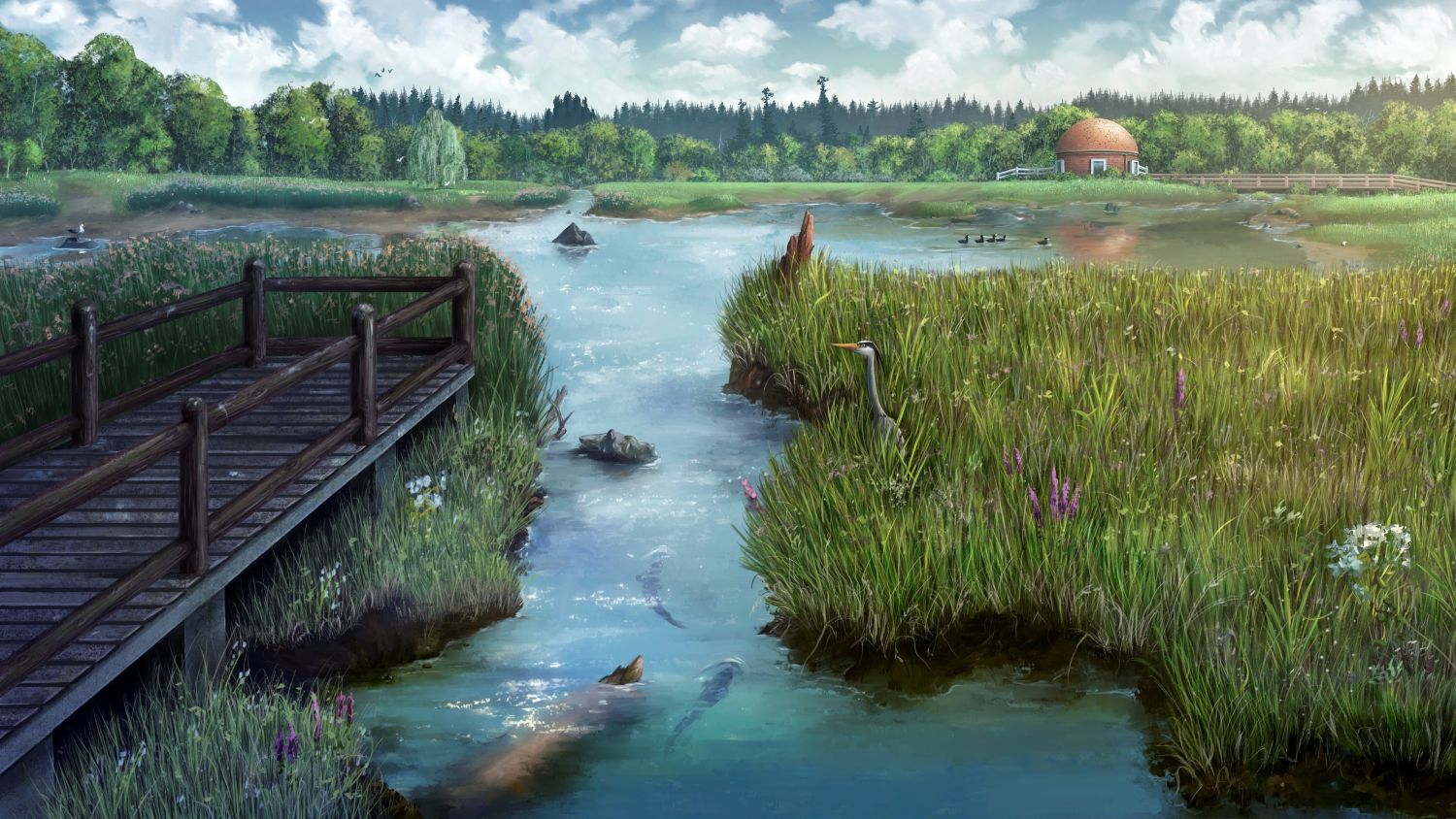
One noteworthy personal piece is a painting I entered into an art contest a few years ago to support a wildlife conservation initiative. I got an honorable mention which was nice considering I was the only digital artist who won a prize. In this painting, the storyline was to represent a local marsh, which activists feel should be restored to a functioning tidal estuary. The options were to paint the marsh as-is, or as it could look restored. I was fascinated with the latter and I knew not many artists would approach it from that angle.
 Tidal Estuary (2023). A painting entered into a local art contest and won Honorable Mention. Painted in Rebelle 6 with custom brushes and lots of layers. Upscaled with NanoPixel and printed on a large 16:9 stretched canvas.
I usually have at least a rough idea in my mind of what I want to create so I often start there. The rest is just figuring out how to lock it in visually with references and sketches. I went to the marsh and took photos of the landscape and vegetation, studied aerial maps to help me envision how the estuary would look if it were restored, and went to the Ballard Locks to gather references of live salmon as they ascended a fish ladder.
Next, I cobbled my references together in Photoshop to create a mockup. This allowed me to develop the concept gradually. After that, it was just a matter of sketching and painting with custom brushes in Rebelle.
I had a feeling I might be the only digital artist in the contest, so to avoid anyone downplaying my work as AI-generated, I made sure to fully document my process. I was proud to impress the judges who saw the actual effort that went into drawing every individual blade of grass.
I ended up spending all of my prize money (and then some) having the work printed so that it could be placed on exhibition in a local café along with the other prize winners.
Although there were commercial elements to it, I consider this to be personal art because I was passionate about the cause it was supporting. It also symbolizes my triumph over prejudice against digital artists.
The painting is hanging on the wall in my office, and it brings me joy to look at.
Which artists or content creators have inspired you along the way, whether creatively, technically, or through the way they share their work with others?
I am a big fan of Salvador Dalí. When I was heavily into surrealism, I got a lot of my inspiration from his work. I appreciated Dali’s ability to paint realistically while bending reality in a way that provokes thought through a hidden context. I used to love when people would spend time figuring out the meaning of my work, but now I endeavor to make everything obvious. Artists can be fickle that way. I fancy the idea of giving up laboring over impressive still-life to retire in abstracts.
I have been fortunate to work with a lot of very interesting creative people, some of them quite famous artists. Having those folks believe in me and look to me as a learning resource has done a lot to build my confidence. I have a special place in my heart for the work of Gary Larson, who has taught me that you can be famous and still be humble.
I must also give credit to my fellow YouTube creators who have shown me that you can be successful just by being yourself and doing what you love. James Gurney and Aaron Blaise are some veteran artists who have inspired me along the way.
 Rebelle 7 Apple (2024). A juicy red apple painted with custom brushes in Rebelle. The .reb version is overlaid with Metallics, so the apple reflection changes as you pan the canvas.
"The feedback I get is 99% positive and 1% negative, but man, does that 1% bother me sometimes. I don’t think there’s any escaping that, though I wish it weren’t the case."
As an artist who thrives on the cutting edge of digital art technology, are there any interesting projects you’ve worked on that you’d like to share?
My expertise in all things digital art recently brought about an extraordinary opportunity. I was asked to create brushes and other assets that were used in a light show for Pink Floyd’s David Gilmour during his 2024 ‘Luck and Strange’ tour. I was able to help create something new in the digital art field and experience some of the heights of what digital artists can accomplish.
Watch on YouTube: youtube.com/watch?v=nYoaZ0IX1S4
At a time when it was feeling like my bubble had burst, this experience opened my eyes to my true potential. I know this wasn’t an opportunity I could expect every month, but coupled with other remarkable experiences, I feel like my passion for art has taken me places many artists only dream of.
Online art communities can be both deeply supportive and, at times, overwhelming. How engaged are you with your comment sections, and how do you protect your creative energy when navigating negativity online?
This question really captures the sentiment well. I go through phases of being highly engaged and then not much at all. I have vacillated between burning down all comments and accepting that negativity is just par for the course. If I’m being honest, the feedback I get is 99% positive and 1% negative, but man, does that 1% bother me sometimes. I don’t think there’s any escaping that, though I wish it weren’t the case.
Over time, it is possible to build immunity to comments. Non-constructive criticism is like a bad smell: The first few words give you a whiff of what’s cooking, and if you’re smart, you’ll delete the comment rather than reading it. I’ve found that engaging with your critics just sucks your energy and leaves you with less for making art, so I have become better at avoiding that.
Currently, I’ve settled on a good middle ground which is to use YouTube’s “Hold All Comments” feature. This allows me to deal with comments that bother me before the public can see them. I find it diffuses my emotions that way. Half Coconut (2026). Made with custom Rebelle 8 bristle brushes. This was created to show off Rebelle’s RealShader and SoftShadows.
When you create content for Patreon or your premium courses, how does your relationship with your supporters shape the tone, focus, and heart of what you make?
Patreon is an interesting thing: Either you can’t even make $1, or you are fully committed to making art for money… for life. People who are financially invested in your productivity are a great motivator. I have to make something new every month: there’s no way around it.
If I didn’t have these obligations to make art, I wouldn’t be nearly as prolific. But aside from the obligation, it also feels really inspiring that each of these people spends their hard-earned cash on me because they want to see me thrive. Self-confidence and validation are not always easy to come by in the art world, so having a community of people supporting your art is extraordinary.
It's not one-sided, though. I give a lot to the digital art community. My altruism is why people are motivated to give back. I think that’s what a lot of artists are missing when they feel like memberships aren’t working out for them. My passion for art comes first, and the business aspect is simply what makes it possible for me to keep pursuing it.
Watch on YouTube: youtube.com/watch?v=OFw4jcBjQKs
Looking ahead, how do you see the role of digital artists and educators evolving in a fast-changing digital landscape? Are there any shifts you’re making, or considering, in your workflow or creative approach to ensure your voice continues to resonate and stay meaningful?
It’s hard to ignore the role AI is playing in everything. I hear a lot of talk about AI replacing artists, so naturally, it’s something I have to consider. Objectively, based on the fact that people still watch my videos, I can see that human-made art is still highly valued. Though in my heart, I know that it will always be appreciated. Disruptions are a part of life, but I don’t sit around worrying about how something is going to permanently destroy my ability to make art for a living. I’d much rather find solutions and adapt.
There’s no doubt in my mind that some people would opt to generate something rather than hire me to paint it. But I’m also certain that people still want me to draw things by hand. My fans are interested in what I am expressing as an artist. I can provide that same experience consistently because I am a genuine person with a purpose. I have dreams and aspirations. I am not just a machine arbitrarily churning out images.
Digital art has been around for decades and yet there are still far more people who choose to make traditional art. Many of these traditional artists would never touch a Wacom tablet, and many art collectors will never see my work as real art. Digital art is doing a pitiful job of replacing traditional art, and I don’t believe AI-art will replace anything either. I am not threatened by AI-art any more than I am threatened by a crayon. Oak Mountain (2024). Painted in Rebelle 7 with custom palette knives that can be rotated using the Wacom Art Pen. This was a project for a landscape painting course.
People are already using technology to segregate AI-art from human-made art, so I believe AI-artists will be mostly competing with each other. Sure, there will be some crossover, but I think digital artists are already in their own lane, so to speak. Do what you do and do it well. If you’re good at that, you’ll enjoy art more and have more success with it.
Regardless of how you feel about AI-art, it has put us into a category of “Human Artists”: we need to lean into that and use it as an advantage, not a disability. There’s no better time to record your process and share it with others. People are going to become weary of seeing AI everywhere and seek out human experiences. This is actually the best time to be a Human Artist.
In the long-term, I believe that the hype around AI will die down, and it will just be another tool we use to make certain elements of life less mundane. I believe developers who are passionate about art will continue to pursue the most natural medium simulation possible. Digital art software will continue to become more sophisticated as hardware progresses, and we will begin to see more physical tools like bristle brushes and palette knives. I also think 3D printing will allow for more natural digital art prints that have real depth rather than a pseudo-texture. Perhaps the printer will deposit real oil paint.
I don’t see digital art becoming obsolete or irrelevant. I think we’ve barely passed the point of acceptance in mainstream art, and there is still a long way to go.
I am optimistic that my uncanny interest in digital art and my talent for communication will provide for me as long as I exist.
Thank you, Aaron, for sharing your thoughts and experience with digital art and content creation around it. May your spark and enthusiasm never waver. Thank you for your service to the digital art community in tutorial preparation, reviews, and sharing of your knowledge.
Happy Painting,
Escape Motions Team
-----
Learn more about Aaron Rutten: Youtube.com/@AaronRutten
Rebelle channel: Youtube.com@AaronRuttenRebelle
Courses from Aaron: aaronrutten.com/rebelle
What do you think?
0 Responses
0
Upvote
0
Funny
0
Love
0
Surprised
0
Angry
0
Sad
Sign in to comment!
Be the first to comment.