
We are thrilled to introduce Lost Pombo, Rebelle Featured Artist with a background in painting and 2D animation. Learn about his approach to creating mysterious elements and a weary atmosphere.

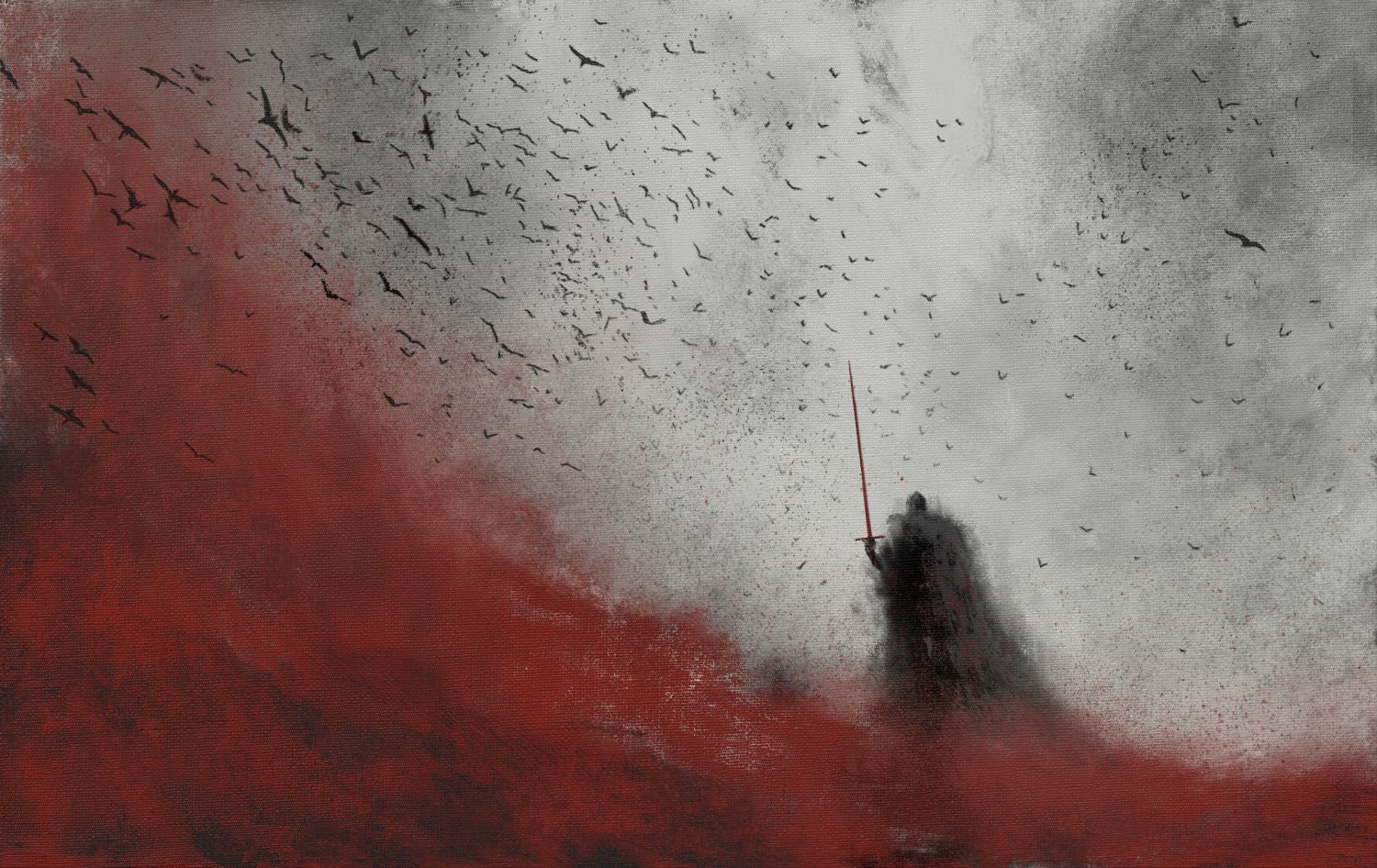
Lost Pombo is a UK-based artist with a background in 2D animation and artworking. His work explores dark fantasy through mood-driven compositions that emphasise scale, isolation, and atmosphere. Using Rebelle, he builds depth through stark contrast, textured surfaces, and controlled use of light, often reducing subjects to silhouettes within vast, abstract environments. His pieces prioritise presence over detail, creating a sense of tension and quiet narrative.
With Halloween approaching, it feels like the perfect time to talk about your art. Dark fantasy is a recurring theme in your work, yet the imagery rarely relies on obvious fantasy elements. What draws you to creating worlds that feel mysterious rather than explicitly explained?
I think it comes from my influences growing up and wanting to tell a story through my eyes. Growing up in a religious household, to a certain degree, I was made to believe in the supernatural. As I grew older, that belief, of course, went away, but the feeling that there is always something in the corner of my eye never left.
It's that idea that there might be something there, something unsettling, that I like to create. I don't want to tell you what it is, or how it makes you feel. I believe that if I say too much, it stops being interesting.
"I play a lot with lights and darks, but at the end of the day I just want to make something interesting that captures the mood. Because light is not just a light source; it can be emotion, a feeling."
As you mentioned, there is often something unsettling about your work without it necessarily being frightening. How do you create that sense of tension without revealing where the danger might come from?
I think tension happens naturally when we see something unsettling or can't explain it. An open door to a dark room, or the thing under the bed that is obviously not there and yet we wonder.
We are curious creatures, and a lack of information can leave us unsettled without necessarily being frightening. Horror films often use the same concept. But tension is never at the forefront of my mind. I aim to make something interesting and captivating. Maybe tension is simply the result of a good composition within the silence.
Light plays a very controlled role throughout your work. How do you decide where the light should fall, and what you want it to reveal or leave hidden?
It all comes down to what's interesting; my work process is mostly through gut feeling. If something feels right, I leave it; if something doesn't, I change it. I play a lot with lights and darks, but at the end of the day I just want to make something interesting that captures the mood.
Because light is not just a light source; it can be emotion, a feeling. The way artists like William Turner and Caravaggio used light always moved me. If I can evoke even some of that feeling in someone looking at my work, then I am pleased.
Many of your compositions have a cinematic quality. When creating a piece, do you approach it similarly to a film director framing a shot, thinking about scale, lighting, what sits within the frame, and what might exist just beyond it?
That's very interesting because you're quite right. I would say I study film directors more than I study painters. Film directors like Ridley Scott, Stanley Kubrick, and especially Andrei Tarkovsky are a great inspiration to me.
I think composition is the "secret sauce" of any good piece of art, whether it's painting, design, film, or anything else. I am always aware of what I'm including and, most of the time, what I'm leaving out. It might be the filmmaker in me, but I always think of the "why and how" of everything, because the scene came from somewhere and will go somewhere. It's a snapshot of a continuous moment, and that's always how I approach a composition or a character.
"I still remember the first time I saw a painting made with Rebelle. I looked closely and said out loud, "That's impasto." I had been looking for years for something that could recreate the textures of real paint digitally."
With a background in 2D animation, how has that experience shaped the way you approach your artwork today?
I have never seen myself as a painter. I would say I am an animator, a filmmaker, or a designer before a painter, and that's important. Both animation and design have led me to be very conscious of composition: Where is the viewer's eye going? Am I capturing the right attention? Is the overall frame too busy?
And then there is the storytelling aspect of what's going on. I want my audience to wonder about what they are looking at. Honestly, even I don't know the story. With animation, I write a script. With painting, I let it wander. Just like we don't know the story of everyone who walks past us in the street, yet we know there is one.
Rebelle has become an important part of your process. What was it about the software that clicked with the way you wanted to create these textured, atmospheric environments?
I never liked creating digital art much. I always felt more connected with traditional art, and I did try my fair share, but the cost of oil paint in particular, plus the space needed for canvases, always stopped me from sticking with it, eventually leaving me with a wardrobe full of, honestly, not very good paintings.
I still remember the first time I saw a painting made with Rebelle. I was scrolling through Instagram and just froze, looked closely at my phone, and said out loud, "That's impasto." I had been looking for years for something that could recreate the textures of real paint digitally. I must have installed hundreds of Photoshop and Procreate brushes to no avail.
If I had to pinpoint it, it would be the way paint and tone interact with each other in Rebelle.
Although created digitally, your work has a remarkably tactile, almost physical quality. How important are traditional materials such as paint, texture, and blending when it comes to building that sense of atmosphere?
Knowing that feeling comes across is incredibly rewarding because it is often my intention. I've always preferred traditional to digital art, and often find myself reverse-engineering how I would apply ink or paint on paper and trying to reproduce it in Rebelle.
With traditional art, the materials automatically create roughness and texture, but with digital art we need to be mindful that it might otherwise come out looking flat and sterile. When talking about atmosphere specifically, for me blending is by far the most important aspect. The way tones blend together depending on the brush, combined with only using one or two layers, really dictates the outcome of a painting. It's always about a search for emotion; there is never a set outcome.
"I always return to quiet emptiness, perhaps silence. The stillness of a moment has always captivated me, and I find that to be my sense of beauty."
When working in Rebelle, are you aiming to recreate the experience of traditional painting, or do you also deliberately explore possibilities that only a digital medium can offer?
I wouldn't say I'm necessarily aiming to recreate traditional painting, but I would say it has unintentionally become part of my workflow.
I have mentioned it before, but I work mostly by gut feeling, and a lot of the time I use just a single layer. Almost treating it like a conversation, sometimes the way a stroke interacts with the canvas is unexpected and rather than undoing it, I respond to it with another stroke and so on.
But I never forget it's a digital medium, and sometimes I might play with layer effects or Rebelle's own visual settings, like changing the impasto depth or the canvas texture.
Your work often prioritizes presence over detail. Why do you think a more stripped-back image can sometimes have a stronger impact than one filled with information?
It goes back to the principles of design ingrained in me. For example, "less is more" and KISS (keep it simple, stupid) are good examples of the ideology I follow. I also find a type of tranquillity in minimalism that I hope is able to come across.
Funnily enough, part of the reason is also due to my eyesight. Since I was young, I've never been very good at picking out details, so I naturally focused more on shapes and composition. It translated into all my work, where I give priority to the overall balance of an image and almost dislike detail.
Looking across your different works, is there a particular emotion or feeling that you find yourself returning to, even when the subject or setting changes?
I am not sure; I think it just happens naturally, but if I had to name it, I would say I always return to quiet emptiness, perhaps silence. The stillness of a moment has always captivated me, and I find that to be my sense of beauty. I think there is something very beautiful in a moment that doesn't necessarily need to explain itself. There is always something more than the moment itself; a before and an after to every piece.
Finally, when someone encounters a Lost Pombo artwork, what do you hope stays with them after they look away?
Interesting. I hope they find it interesting. Because if something is interesting, you remember it. And to me, there is nothing more flattering than that.
Thank you for letting us peek into your artwork, creative process, and thoughts behind your work. We hope this season brings a lot of inspiration for your next work.
Happy Painting,
Escape Motions Team
-----
Learn more about Lost Pombo: escapemotions.com/featured-artists/lost-pombo

What do you think?
0 Responses
0
Upvote
0
Funny
0
Love
0
Surprised
0
Angry
0
Sad
Sign in to comment!
Be the first to comment.