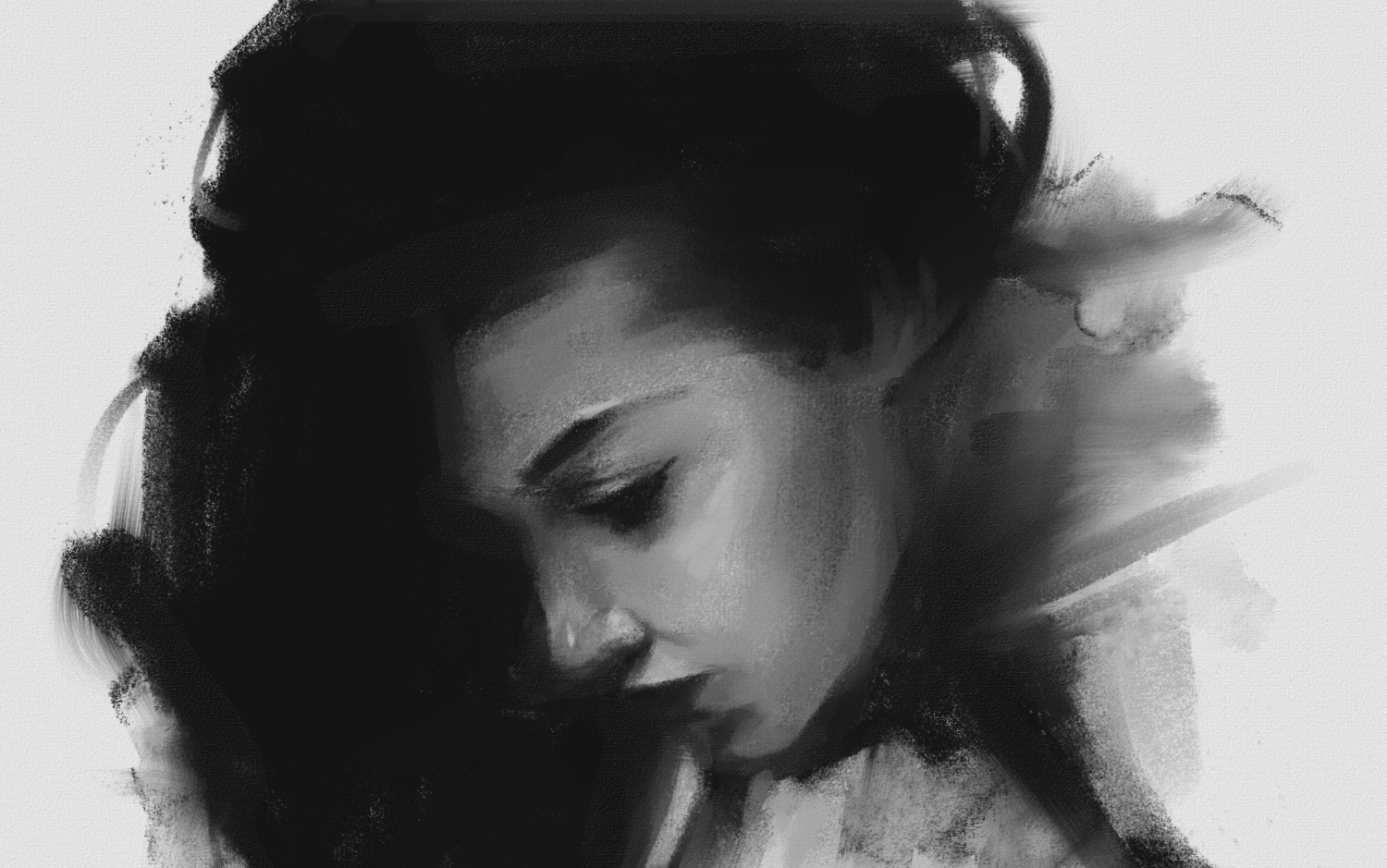

Charcoal is one of the most expressive media an artist can use. It’s messy, tactile, unpredictable, and beautifully bold. It asks artists to work with large shapes, rich dark values, sweeping marks, and textured surfaces. In this study, Daniel Ibanez aims for that same feeling while using digital charcoal in Rebelle.
Watch on YouTube: youtu.be/3ptFRYwRNXc
Unlike a graphite pencil, which often encourages precision and control, charcoal invites a more painterly mindset. The charcoal brushes in Rebelle feel chunky and organic, blending behaves in convincing ways, and even water interactions mimic the unpredictability of real-world materials. Instead of creating perfectly smooth digital renderings, the software encourages artwork that still feels handmade.
But before jumping into polished charcoal portraits or elaborate renderings, it’s important to begin with something much simpler: Notan studies.
Why Notan Studies Matter
Notan is a Japanese concept centered around the relationship between light and dark shapes. At its core, the drawing simplifies an image into two major values, black and white, allowing artists to focus purely on composition and design.
This process is incredibly important because good paintings are rarely built on detail alone. Details cannot rescue a weak composition. Strong artwork almost always begins with clear and interesting value relationships, and Notan studies reveal those relationships immediately.
When you reduce an image to only light and dark masses, distractions disappear. You stop thinking about texture, tiny edges, or surface details and instead begin seeing the image as a collection of abstract shapes. This shift in thinking is one of the most valuable skills an artist can develop.
Working this way also helps train your eye to identify what actually makes an image visually compelling. A successful composition isn’t necessarily complicated. Often, it’s simply a strong arrangement of value shapes.
Setting Up a Simple Workflow
A useful exercise is to gather a wide range of photographic references and work through them quickly. Instead of carefully searching for the "perfect" reference, it can be surprisingly effective to load many images at once and choose randomly from them. Landscapes, harbor scenes, still life, and portraits all work well, especially if they feature strong natural sunlight.
Lighting matters enormously in these studies. Images with clear directional light naturally create stronger shadow patterns, making them easier to simplify into graphic value structures. Flat lighting or overly processed HDR photography tends to muddy those relationships and makes the exercise less effective. One of the most valuable habits during this process is changing the composition instead of copying the photograph exactly. Cropping aggressively, shifting focal points, or reframing the image forces you to make compositional decisions yourself rather than relying entirely on the photographer’s choices. Even simple changes can completely alter the emotional impact of an image.
Eventually, taking your own reference photos becomes an even better exercise because photography itself teaches compositional awareness. But using online references is still an excellent way to practice seeing.
Thinking in Shapes Instead of Lines
Perhaps the biggest shift when working with charcoal is learning to think in shapes rather than outlines. Many artists are taught to draw by tracing edges. They look for the contour of the face, the edge of the boat, or the outline of a tree. Charcoal encourages a different approach. Instead of drawing the object itself, you begin drawing the shape of the shadow, the shape of the reflected light, or the large dark mass created by overlapping forms. This way of seeing transforms drawing into painting.
Rather than constructing a "coloring book" of enclosed outlines, the image emerges through layered marks and shifting value relationships. Edges become softer, more dynamic, and more organic. Some disappear entirely, while others sharpen naturally where contrast increases. The result feels alive because it resembles how we actually perceive light rather than how we intellectually categorize objects.
The Importance of Big Strokes
One of charcoal’s greatest strengths is speed. Large strokes allow you to establish major forms quickly and decisively. In portrait drawing, for example, a single broad mark can define the shadow beneath the brow ridge or the underside of the cheekbone. Instead of slowly building tiny details, you begin by organizing the largest shapes first.
This process is not only efficient but also psychologically important. Big strokes force confidence. They prevent hesitation and encourage simplification. Many artists struggle because they attempt to control every edge too early. Charcoal rewards the opposite mindset. It asks you to commit to bold marks, accept imperfections, and trust the process.
Even digitally, it can be useful to avoid relying too heavily on Undo. Sometimes mistakes introduce unexpected textures or compositions that ultimately improve the piece.
Building Complexity Gradually
Once a strong two-tone Notan study exists, additional complexity can be introduced carefully. A simple midtone often becomes the next step, transforming a flat graphic image into something more dimensional. This three-value structure (light, midtone, and dark) creates a bridge between pure design and full rendering. Suddenly, subtle planes of the face begin to emerge. Cheeks gain softness, shadows become atmospheric, and forms feel more sculptural.
What’s important is that the image remains grounded in simplicity. The Notan structure underneath continues supporting the composition even as details and tonal nuance are added on top. This layered approach mirrors the way many traditional painters work. Strong paintings often begin with extremely simple value foundations before gradually developing into richer, more complex surfaces.
Portraits and the Language of Light
Portrait drawing naturally fits this process because the human face is fundamentally a landscape of planes responding to light.
When simplifying a portrait, squinting becomes incredibly useful. As the eyes narrow, smaller details disappear, and shadow masses merge together. The eye sockets, hair, cheek shadows, and underside of the jaw connect into unified dark shapes.
This simplification is powerful because it helps organize the portrait clearly. Instead of becoming overwhelmed by eyelashes, pores, or tiny anatomical details, the artist focuses on the larger structure of light itself. That simplicity often produces stronger and more convincing portraits than over-rendering ever could.
Preserving the Human Touch
One reason charcoal feels so compelling today is that it retains visible evidence of the artist’s hand. In an era where much digital artwork becomes overly polished and sterile, textured brushwork and imperfect edges feel increasingly valuable.
Rebelle excels in this area because its brushes behave more like physical tools than digital stamps. Charcoal dust scatters naturally, water creates believable distortions, and blending feels tactile rather than artificial. This physicality matters. It creates artwork that feels interpreted rather than mechanically generated. The goal is not perfection. In fact, overworking is often the fastest way to destroy the life of a drawing. The challenge is learning how to refine an image while preserving its freshness.
Finishing Without Killing the Drawing
The last phase of a charcoal piece is often subtle and slow. Highlights are adjusted carefully along the brow ridge, the nose, or the lips. Edges are softened or sharpened selectively. Small transitions are blended while preserving enough texture to keep the drawing alive. This stage requires restraint.
A drawing can become "finished" surprisingly quickly, but making it feel complete without becoming overworked is far more difficult. Often, the final ten percent of refinement takes half the total working time.
One helpful habit during this stage is staying zoomed out. Many digital artists spend too much time magnifying tiny details. Traditional painters constantly step away from the canvas to judge the entire image from a distance, and digital artists benefit from doing the same.
A successful artwork must function as a whole before its details matter.
Final Thoughts
Digital charcoal drawing is powerful because it combines the expressive energy of traditional media with the flexibility of digital tools. Through Notan studies, bold value organization, textured mark-making, and careful simplification, artists can create work that feels deeply human and visually compelling.
The real lesson behind charcoal drawing isn’t simply about mastering a medium. It’s about learning to see differently, to think in shapes instead of outlines, in light instead of objects, and in design instead of detail.
Once that shift happens, everything about drawing begins to change.
Happy Drawing,
Escape Motions Team
----
Reference images for this tutorial: download here
Daniel Ibanez is a fine artist and illustrator who works out of beautiful Colorado. He grew up plein air painting mountain landscapes and western imagery. He has a love of painting the human figure, portraits, and landscapes. Daniel has worked on films, comics, video games, and tabletop games. While his range of subjects is diverse, all of his work is rooted in his traditional art background. He has been an oil painter since he was 13 years old. His work covers a wide spectrum of subjects, from sci-fi illustrations to alla prima landscapes. He has a digital portrait painting class with Domestika and a growing YouTube channel for tutorials and demonstrations. Find him on Instagram and say hello!

What do you think?
0 Responses
0
Upvote
0
Funny
0
Love
0
Surprised
0
Angry
0
Sad
Sign in to comment!