
Welcome back to the Rebelle Art School series with Daniel Ibanez. In this second tutorial, we’re diving deeper into how lines can shape the way we see and draw the world around us.
In the first part, we explored contour drawing, learning to follow the edges of forms with pure observation. Today, we’re going to shift gears into a more structural way of thinking: construction drawing and cross-contour. These two approaches are like the backbone and heartbeat of your drawing practice. Contour teaches you to see, while construction and cross-contour teach you to build.
Watch on YouTube: youtu.be/byRJQz0sSiY
From Contour to Construction
Last time, we looked at line as a way to describe what we see. Now we’ll look at line as a way to understand what we draw.
Construction drawing is about breaking down complex subjects into simple, three-dimensional shapes like spheres, cylinders, cubes, and cones. When you start to see the world in these building blocks, you’re no longer just copying outlines. You’re constructing your subject as if it exists in space.
Take something simple, like a pear. Instead of tracing its contour, imagine it as two spheres stacked together, connected with soft transitions. That’s construction. You’re designing the form beneath the surface, understanding how light might wrap around it and how it exists in perspective. This way of thinking is especially powerful when drawing the human figure. If you think of the head as an egg, bisected by a center line, and the torso as a shaped cylinder or block, you begin to create a solid foundation. Every limb, joint, and gesture can then be built on top of these forms.
Unlike contour drawing, which thrives on intuitive observation, construction drawing is more analytical. It’s about deconstructing the complexity of the world into familiar, manageable parts. And in doing so, you start to train your brain to think in three dimensions.
Revealing Depth with Cross Contour
Let’s turn now to another powerful tool in the artist’s arsenal: cross-contour.
If contour describes the outer edge of an object, cross contour describes the surface itself. It’s as if you could draw across an object with a Sharpie, wrapping your lines around it to reveal its volume and curvature.
Imagine that same pear again. If you were to draw lines that follow its form, curving over its surface like topographical lines on a map, you’d begin to sense its roundness. These lines bend and shift depending on where the light hits, where the form turns away, and where perspective changes. This concept also applies to any cylindrical or spherical form. A can of soup, a teacup, or even a human leg. The top curves of these forms differ depending on your eye level. Above your eye line, ellipses curve downward; below it, they curve upward. Understanding this subtlety gives your drawings an incredible sense of dimensional accuracy.
Cross-contour is like the skeleton key for unlocking perspective and form. When done thoughtfully, it can make even a simple sketch feel alive, solid, and grounded in space.
Bringing It All Together: Drawing the Eye
Now that we’ve explored contour, construction, and cross contour, let’s put these concepts to work.
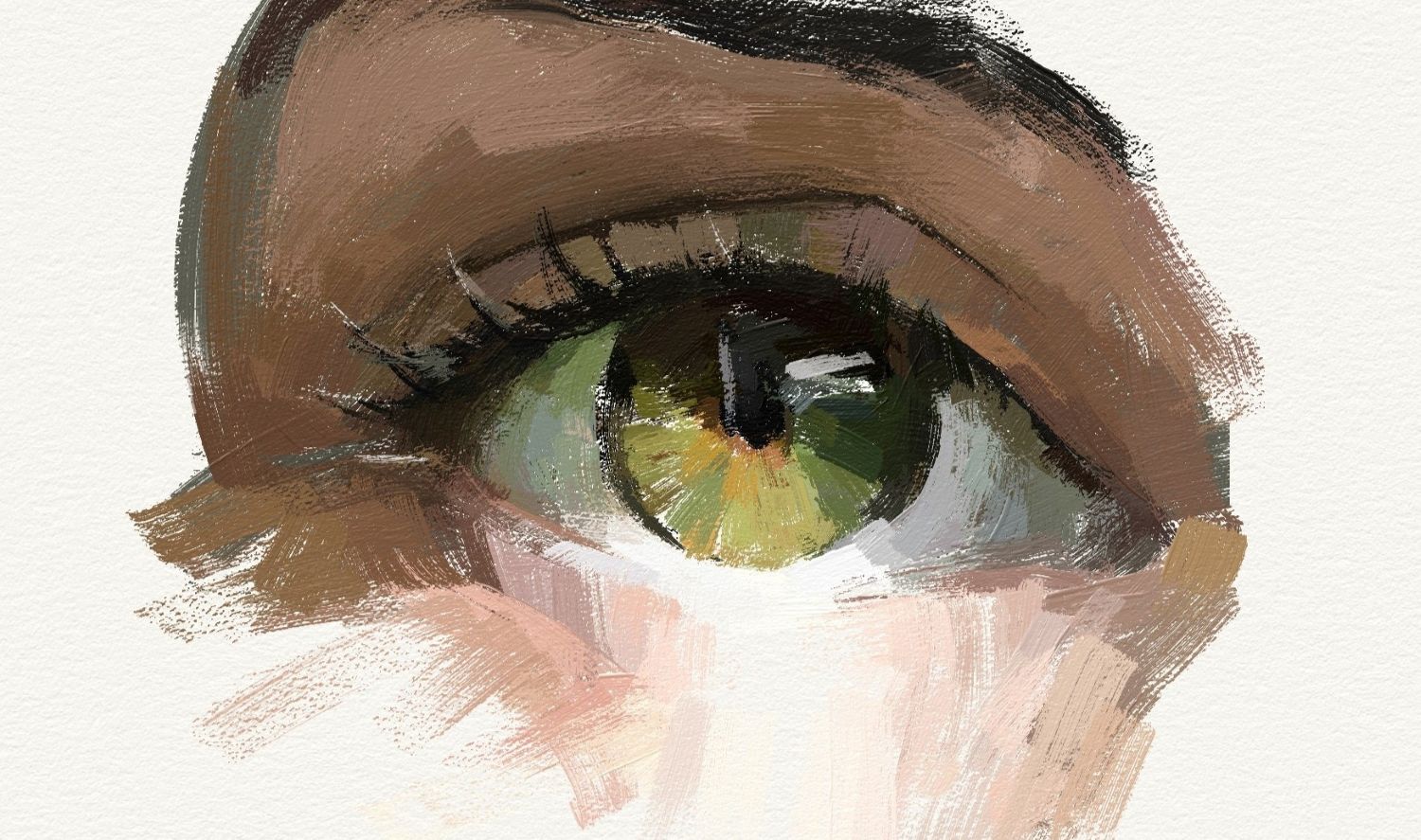
A perfect subject for this integration is the human eye, a small, contained form that’s rich in complexity and structure. Start with contour: capture the flowing edges of the lids, the delicate curves of the lashes, the subtle planes of the surrounding skin. Then, bring in construction: imagine the eyeball as a sphere nestled into its socket, the lids wrapping around it like soft, protective shells.
Next, layer on the cross contour. Draw gentle curved lines over the sphere to visualize how the surface bends. Follow the direction of the eyelids and let the lines help you feel the roundness of the eye. These lines can be drawn in two directions, vertically and horizontally, giving you a better understanding of the eye’s full three-dimensional shape. As you do this, notice how the thickness of the eyelids emerges, how the planes of light and shadow reveal themselves.
Once your structure feels solid, begin painting. Start simple with a five-value study (dark, midtone, light, and two transitional values). Assign each plane of the face and each part of the eye to one of these values. Don’t worry about getting it perfect. Focus on accuracy in the relationship. The goal is to translate structure into light. Then, in Rebelle, use the blending tools to soften transitions and unify your tones. Try the color blend mode on a new layer to glaze in subtle skin tones like pinks, greens, and warm neutrals, without losing your underlying value structure.
 The beauty of this process is in the layering: line supports form, form supports value, and value supports color. Each step builds on the last, guiding you closer to a convincing, dimensional image.
Integrating What You’ve Learned
Once you’ve spent time with contour, construction, and cross contour, you start to internalize these ways of seeing. Eventually, you won’t need to draw every construction line or map every contour because the understanding will already be there in your mind and hand.
That’s the magic of this kind of practice: each exercise refines your perception and strengthens your intuition.
In time, you’ll be able to jump straight into painting, thinking in volumes and planes even when you’re working directly with color. The structure and form will naturally inform every mark you make. So keep exploring, keep experimenting, and remember: line isn’t just a boundary, it’s a bridge between observation and imagination. Do not hesitate to share your practice sketches on our forum.
Happy drawing,
Escape Motions
-----
Daniel Ibanez is a fine artist and illustrator who works out of beautiful Colorado. He grew up plein air painting mountain landscapes and western imagery. He has a love of painting the human figure, portraits, and landscapes. Daniel has worked on films, comics, video games, and tabletop games. While his range of subjects is diverse, all of his work is rooted in his traditional art background. He has been an oil painter since he was 13 years old. His work covers a wide spectrum of subjects, from sci-fi illustrations to alla prima landscapes. He has a digital portrait painting class with Domestika and a growing YouTube channel for tutorials and demonstrations. Find him on Instagram and say hello!

What do you think?
0 Responses
0
Upvote
0
Funny
0
Love
0
Surprised
0
Angry
0
Sad
Sign in to comment!
Be the first to comment.