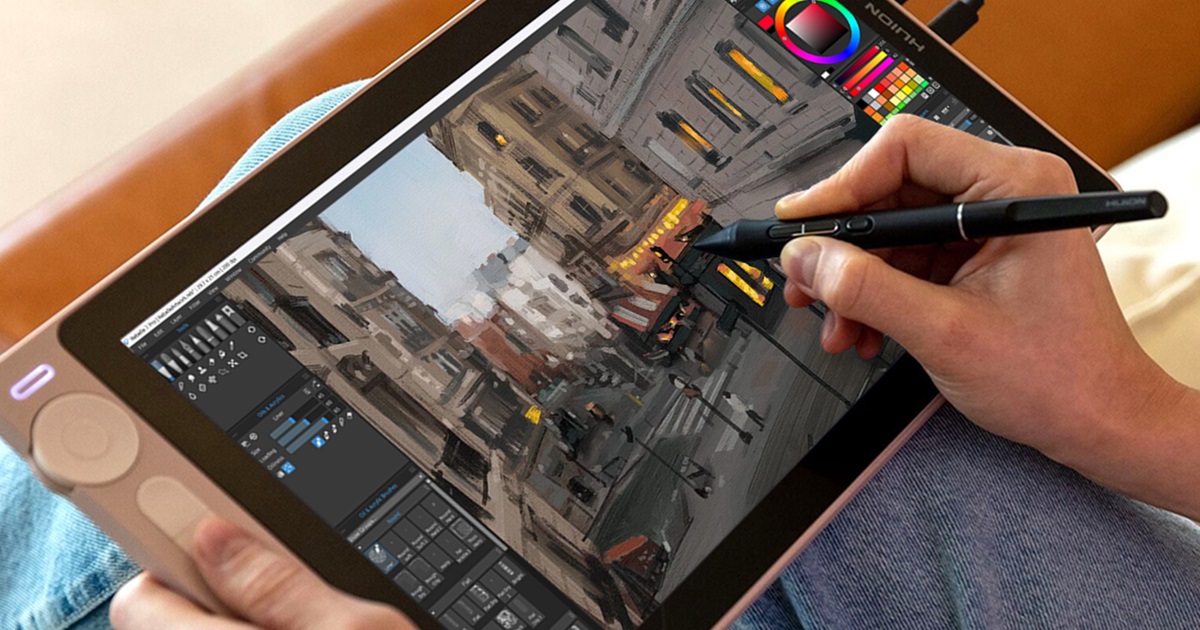
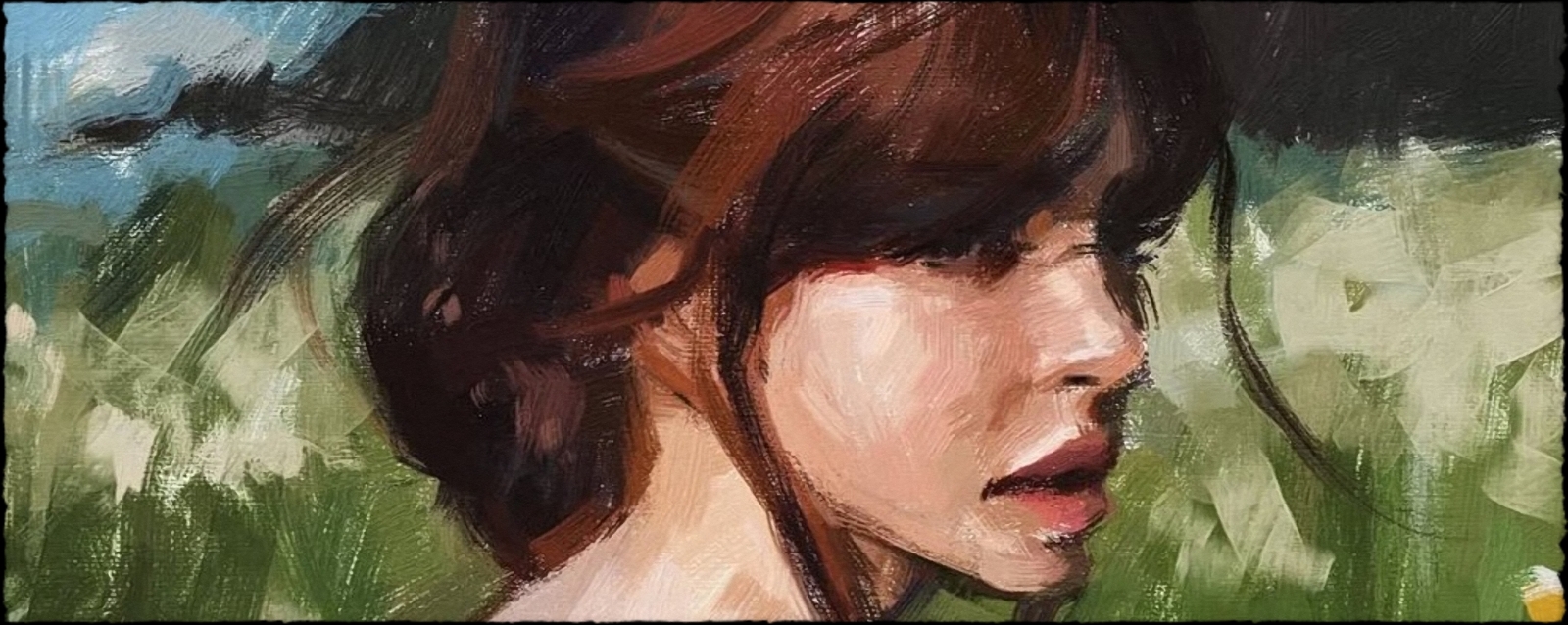

If you love drawing portraits, you’re not alone. It’s one of those skills that feels a bit like a party trick; you can sit down anywhere, start sketching, and suddenly people gather around. There’s something endlessly fascinating about faces. But portraits are also hard. And if you’ve ever tried to draw one, you probably know exactly why. This tutorial, prepared by Daniel Ibanez, will help you with drawing faces and lines.
Watch on YouTube: youtu.be/-qzH5JBRxhg
The Real Problem with Portraits
You sit down and start confidently. The eyes look decent. The nose feels okay. The mouth isn’t terrible. Then you zoom out or flip the canvas, and suddenly the whole face looks like it’s melting. The mouth has slipped too far down, the eyes are drifting off the skull, and what started as a promising sketch now looks like a mutant instead of a human being.
The issue usually isn’t that you can’t draw an eye or a nose. Most people can. The problem is proportion and organization, keeping all those features locked together on a believable three-dimensional head.
That’s not a talent problem. It’s a framework problem.
Drawing success is about how you approach the task. If your mental model of the face is unclear, everything starts slipping around. And no amount of detail will save a drawing that’s built on a shaky foundation. The goal of this tutorial is simple: how do we draw portraits in a way that’s reliable, even if we’re not experienced artists?
A Simple Mental Framework Changes Everything
One of the most important things I’ve learned as an artist is that simple systems create confidence. When you know what to do first, second, and third, drawing stops feeling intimidating and starts feeling approachable.
This lesson builds on an idea popularized by the artist Synix, who teaches a beautifully simple way to think about faces. But we’re going to push it a step further because faces aren’t flat shapes on paper. They exist in perspective. They wrap around a skull. So instead of thinking of the face as a flat diagram, imagine this: Your drawing is on a piece of paper that’s been bent into the shape of a head. Once you do that, perspective enters the conversation naturally.
The “Bent Paper” Head
Start by imagining the face as a curved surface, like a sheet of paper wrapped around a ball. This immediately solves a lot of problems. The far eye starts to curve away. The near eye comes forward. The face begins to feel three-dimensional without you having to overthink anatomy.
Now, on top of that curved surface, we introduce a second idea, a simple organizing shape. Think of the upside-down Superman emblem that angular, truncated triangle shape. Now, imagine placing that shape onto the curved face surface. Inside that shape live the eyes, nose, and mouth. This isn’t about drawing symbols. It’s about creating a container that keeps facial features from drifting. No more eyes sliding off the face. No more mouths sinking too low. Everything stays nested inside a shape that already understands perspective.
When you place that emblem onto a curved surface, it naturally bends with the head. And suddenly, even difficult angles, top-down views, steep foreshortening, and extreme perspective become manageable.
Why This Works (Especially for Beginners)
As artists, we eventually internalize these frameworks. They become invisible. We don’t think about them anymore. But if you haven’t been drawing for decades, those frameworks aren’t there yet. And that’s okay.
What this method does is externalize structure. It gives you something concrete to hold onto while your intuition develops. It turns a complicated problem like drawing a human face in perspective into a series of manageable steps. And once the structure is there, everything else becomes easier:
- Light and shadow make more sense
- Planes of the face feel intentional
- Values fall into place more naturally
You’re no longer guessing. You’re building.
From Line to Light
Once the head is established using the bent-paper surface and the emblem framework, you can start building complexity. Add structure. Refine proportions. Observe where light hits and where it falls away. Even if the lighting is simple or flat, the face still feels believable because the form is doing the work.
This is where everything we’ve learned in the series comes together:
- Contour taught us to see
- Construction taught us to build
- Cross-contour taught us to feel form
- Now structure teaches us to organize complexity
From there, painting becomes intuitive.
I’m primarily a painter. I work impressionistically. I don’t usually sketch faces with rigid systems. But here’s the truth: that freedom only works because the structure is already there in my mind. When I paint a cheek, a shoulder, or the curve of a back, I’m seeing planes. I’m seeing wrapped surfaces. I’m sensing depth even when the brushwork is loose.
If you want to paint realistically, you need some way to translate the three-dimensional world onto a flat surface without constantly fighting proportions. This framework helps with that.
Your Practice Exercise
Here’s the warm-up I recommend: Find four or five portrait references at different angles.
For each one:
1. Imagine the face as a bent sheet of paper
2. Draw that curved surface first
3. Place the upside-down emblem on the face
4. Nest the features inside it
5. Build from there
Don’t rush to detail. Let the structure do the heavy lifting. You’ll be amazed at how much easier it becomes to see the face as a solid object instead of a collection of floating features.
Final Thoughts: Drawing Made Easier
This lesson isn’t about turning portraits into formulas. It’s about removing unnecessary difficulty. Some parts of art should be intuitive, expressive, and creative. Other parts, like keeping the nose from drifting halfway down the face, don’t need to be complicated. Frameworks like this free up mental energy in order to focus on what matters: expression, mood, light, and storytelling.
This felt like the perfect way to close out “The Power of Line” tutorial series of the Rebelle Art School by showing how line, structure, and perspective can come together to make drawing feel simpler, more reliable, and more fun.
Try it out. Share your sketches in the forum. And most importantly, keep drawing.
Happy drawing,
Escape Motions
-----
Daniel Ibanez is a fine artist and illustrator who works out of beautiful Colorado. He grew up plein air painting mountain landscapes and western imagery. He has a love of painting the human figure, portraits, and landscapes. Daniel has worked on films, comics, video games, and tabletop games. While his range of subjects is diverse, all of his work is rooted in his traditional art background. He has been an oil painter since he was 13 years old. His work covers a wide spectrum of subjects, from sci-fi illustrations to alla prima landscapes. He has a digital portrait painting class with Domestika and a growing YouTube channel for tutorials and demonstrations. Find him on Instagram and say hello!

What do you think?
0 Responses
0
Upvote
0
Funny
0
Love
0
Surprised
0
Angry
0
Sad
Sign in to comment!
Be the first to comment.