
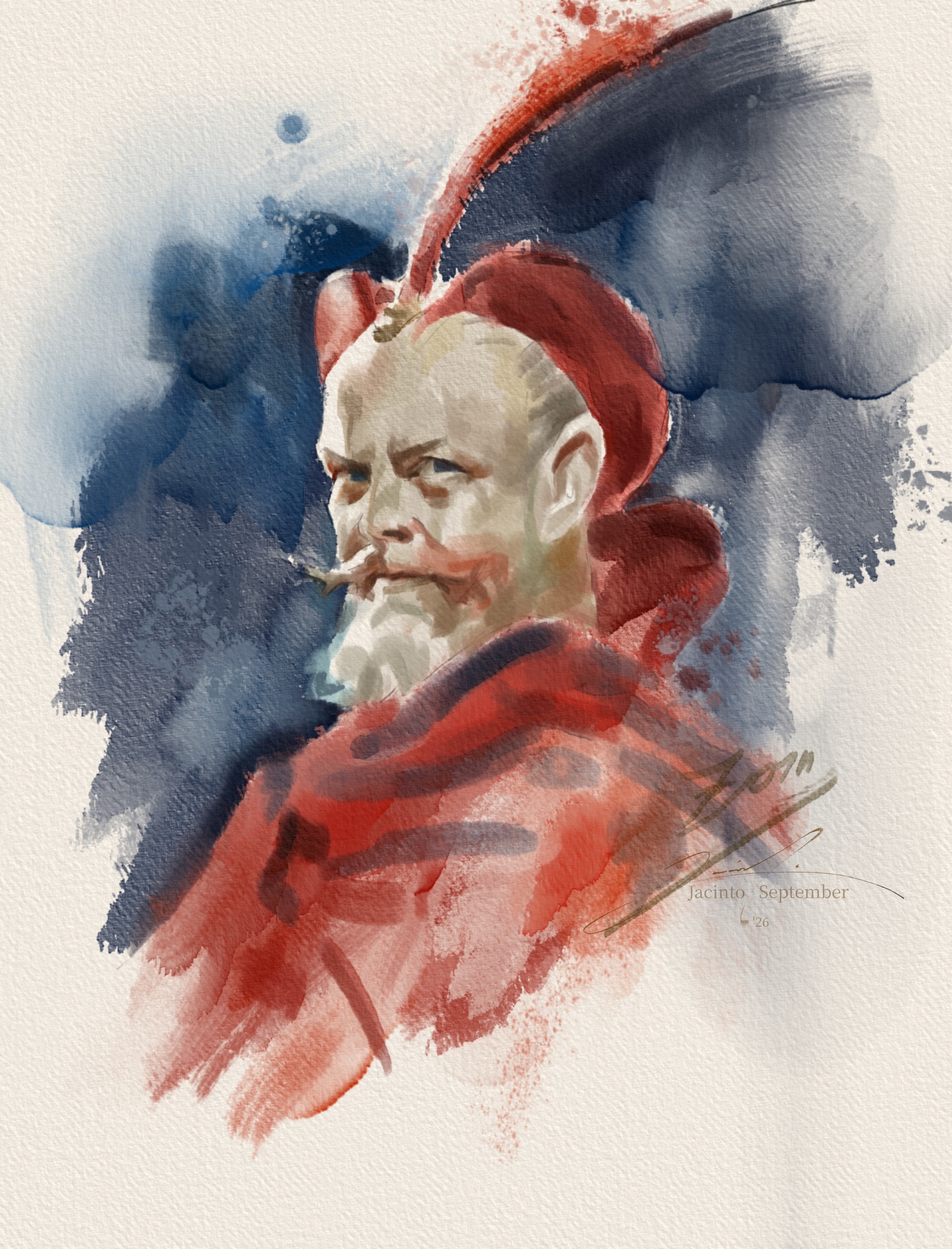

Explore the genius of Anders Zorn and rediscover the masterful clarity behind his watercolor practice. In this study, Jacinto September recreates one of Zorn's striking watercolor portraits, using Rebelle and its dynamic watercolor engine. By analyzing value, temperature, and the power of simplified form, this piece uncovers what truly made Zorn's work so enduring and exceptional.
Swedish artist Anders Zorn (1860-1920) is often acknowledged for his bold and expressive oil portraits, as well as the infamous limited Zorn palette of just four basic colors. But before oils, he was a master of watercolor. What makes Zorn exceptional isn't just his approach and technique, but clarity of thinking.
Watch on YouTube: youtu.be/qk4u7Cq5kik
Why Study Zorn's Watercolor Paintings?
Zorn's watercolor paintings feel effortless, but convincing. He focused on and allowed the fundamentals to do the heavy lifting: strong drawing, clear value grouping, controlled temperature, economy of brushwork, and restraint.
Watercolor is extremely unforgiving. You simply can not rework specific areas without losing a sense of freshness. That's exactly why Rebelle's watercolor engine is such a powerful tool for studying his work. The software responds to the unpredictability. The wetness, pigment load, opacity, and diffusion. And it mirrors traditional watercolor brilliantly. It also forces you to think before you actually paint, to anticipate what could happen.
Step 1: Simple Drawing
Before applying any paint, let's begin with a very simple, but accurate sketch. All that is needed are the basic lines to anchor the proportions and placement and certain shapes. Zorn didn't rely heavily on an intricate drawing. He thought in terms of mass. How one shape relates to another. In watercolor, especially inside Rebelle, applying this is important. Once you place a wash, you have to commit to it (unless you use Undo). The medium can easily reward clarity, but can punish hesitation. So during this drawing stage, the goal is accuracy, not a beautiful drawing.
Step 2: Backgrounds' Importance
One of the first major decisions to recreate Zorn's painting is to lay the wet, blue background. We mustn't underestimate the importance of the background. Zorn used backgrounds strategically. They aren't just empty spaces; they frame the head, and it allows for contrast. Inside Rebelle, adjust the wetness of your brush to allow for natural pigment diffusion. Increasing the wetness of a brush creates soft transitions, while reducing it helps control edges. The key principle here: the background should always support the focal point (which in this case is the head) and not to compete with it. The cool blue enhances the warmth in the face and clothing. And that's called temperature contrast.
Step 3: Protect the Lights
When it comes to traditional watercolor, the white is not painted. It is the color of the paper.
Rebelle works the same way. The untouched surface or canvas becomes your highlight. It is necessary to be cautious in preserving the white of the paper. Of course, Zorn understood this very well. His lights feel luminous because they were preserved early. Instead of painting highlights later, you design around them from the very start. Building up the darks, while 'washing' over the lights. And this forces us to think ahead.
Step 4: Value Before Color
If you squint at Zorn's paintings and especially his portraits, they hold together. The lights are all grouped and read as one mass, while the shadow side reads as another.
Color will always be secondary to value. Remember, when thinking about painting: the understanding of drawing and structure comes first, tonal values second, color and temperature third. In Rebelle, lowering opacity and building transparent layers allows for establishing darker tones gradually. Watercolor is all about building the darks slowly and not jumping to them too soon. The tonal values are very important here. Once the values are clear, everything else should become easier.
Step 5: The Power of Edges
Zorn was a master of lost and found edges. He understood the power. He reserved sharpness for focal areas. In portraiture, this is typically around the eyes, and he allows secondary areas to dissolve. Rebelle's control over wetness and pigment flow allows for this to happen almost naturally. A wetter brush will soften transitions, and a drier brush will increase control. But the most important lesson is all about restraint. Zorn placed strokes confidently with intention and left them alone. Overworking a watercolor painting can kill its freshness.
Step 6: Applying This to Your Own Work
After completing the study of Zorn's painting, apply his principles to your own original portrait. This isn't only about copying or mimicking his style, but trying to think like him. With Rebelle's watercolor brushes, focus on economy of brushwork, brush wetness, and paint opacity. Paying careful attention to where the hard edges should be, and where soft edges apply and diffuse.
Jacinto's painting in Zorn's style reflects the real purpose of doing master's studies. The inspiration wins over imitation.
Final Thoughts
Studying Zorn's watercolors is about understanding why his paintings feel so effortless and strong. When accuracy of drawing, value clarity, and control of temperature come first, the detail becomes secondary. When the structure of a painting is strong, loose strokes feel more decisive and intentional.
When working in Rebelle, try copying a master watercolorist. Not to imitate them, but to observe, analyze, and be inspired. You may find that painting can become easier if you don't focus on the types of brushes and effects, but simplifying the process.
Happy Painting,
Escape Motions Team
-----
Jacinto September, a South African artist who has long been devoted to portraiture and figure painting. Deeply influenced by the old masters, Jacinto is inspired by the use of warm, muted earth tones and the powerful sense of drama achieved through even the simplest portrait.
A traditionally trained, self-taught artist at heart, all of his experience has been shaped by hands-on work with traditional paints, embracing the tactile process and, quite literally, getting his hands dirty. This strong traditional foundation made the transition to digital painting seamless, particularly when working with Rebelle.
Reference images used for the study:
https://share.google/y9jgIeng74g9nx0ke
https://pin.it/4r9MFpDdc

What do you think?
0 Responses
0
Upvote
0
Funny
0
Love
0
Surprised
0
Angry
0
Sad
Sign in to comment!