
Blue and yellow make green. Premise kids have been taught in elementary schools, a principle so simple, one would think it works universally. This might be partially true in a real-life, but in digital painting the color mixing is much more complicated. Despite the huge complexity and difficulty, we’ve created something extraordinary for the upcoming Rebelle 5. Something that will bring digital color mixing on a computer as close to the real world as possible. Something that was not possible until NOW.
Before we tell you more about the exciting news, let us explain why mixing color on a computer is entirely different from natural media. Color system in the computer world is based on RGB color mixing, while in reality it is based on paint pigments. You may ask, what is the color system anyway? Well, a color system is a method by which color is reproduced. We know two primary color systems:
Additive color system - RGB representation
This color model describes how light produces the color. The base additive colors are red, green, and blue, or RGB. It gives us a cube with three sides: R, G, and B. Additive color starts with black and adds red, green, and blue light to produce the visible spectrum of colors. As more color is added, the result is lighter. When all three colors are combined equally, the result is white light. In the middle of the cube is a gray color.
The additive color system is used by light sources, such as televisions and computer monitors, to create a wide range of colors. When different proportions of red, green, and blue light enter your eye, our brain can interpret the different combinations as different colors.
Digital software is also built around such RGB representation, which models the mixing of colored lights. Mixing blue and yellow in a painting software gives you a grayish color instead of green because they are opposite in the RGB cube. When we mix them, we get the color in the middle of the cube – gray.
Subtractive color system - Pigments
In the subtractive color model, pigment is used to produce color using reflected light. This color model is used in printing, silk-screening, traditional painting, and other mediums that add pigment to a substrate. The subtractive colors are cyan, yellow, magenta, and black, also known as CMYK.
With the real paint pigments (e.g. Cadmium Yellow, Alizarin Crimson, Ultramarine, etc.) it gets even more complicated because nature and its chemistry get involved. To put it simply, the real paints get their colors from the mass of pigment particles, which absorb and scatter the light in a complex fashion. This has been studied and reproduced by the model of Kubelka and Munk [1931], who were the first to predict the behavior of pigment mixtures. Despite such a model having been introduced, it has never been picked up by graphics software outside the research because the physics behind it is so complicated that it is almost impossible to use it practically in real-time.
Coincidentally, Peter Blaškovič, the founder of Escape Motions was approached by Šárka Sochorová, a friend from Czech Technical University in Prague for internship opportunities. After a throughout discussion, together we decided to explore the depths of the existing color systems and finding a solution for an efficient implementation of the real-world color mixing into Rebelle software.
The question Peter asked at the beginning of this research: ‚How could we achieve the most realistic color mixing in Rebelle?‘
From such a "simple" question, numerous complex issues have arisen along our way of research and development. Šárka and her friend Ondřej Jamriška, an old-school coder who also worked on this project, went deep down into the "rabbit hole" filled with colors. During the next year and a half, they bumped into many implementation and optimization issues, fought unknown bugs and eerie creatures :-) but in the end, they came out with an amazing solution. We defined what we expected from the color mixing, made a thoughtful selection of the traditional paint pigments for which we needed to mix color frequencies, made many more optimizations in Rebelle, and finally – we successfully managed to achieve something extraordinary.
Finally, let us introduce you to unparalleled Rebelle Pigments!
This is a BIG DEAL. The traditional artists know what to expect when they use Titanium White, Cadmium Red, or Prussian Blue. Because our color mixing is based on real pigments, the colors in Rebelle 5 are mixed very realistically - basically the same way as the colors in the real world. And the results are incredible!
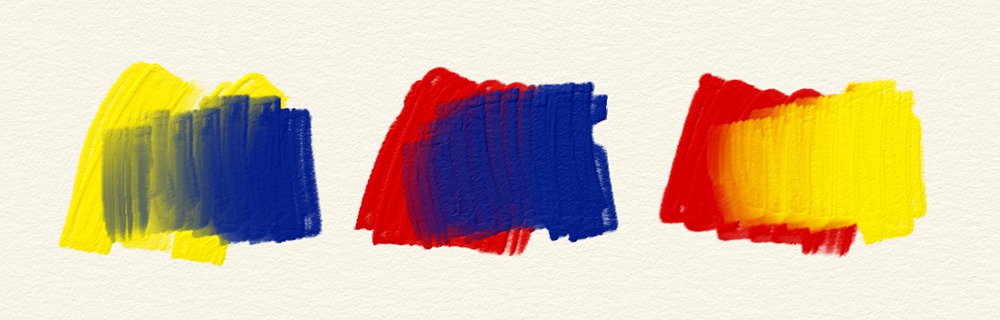
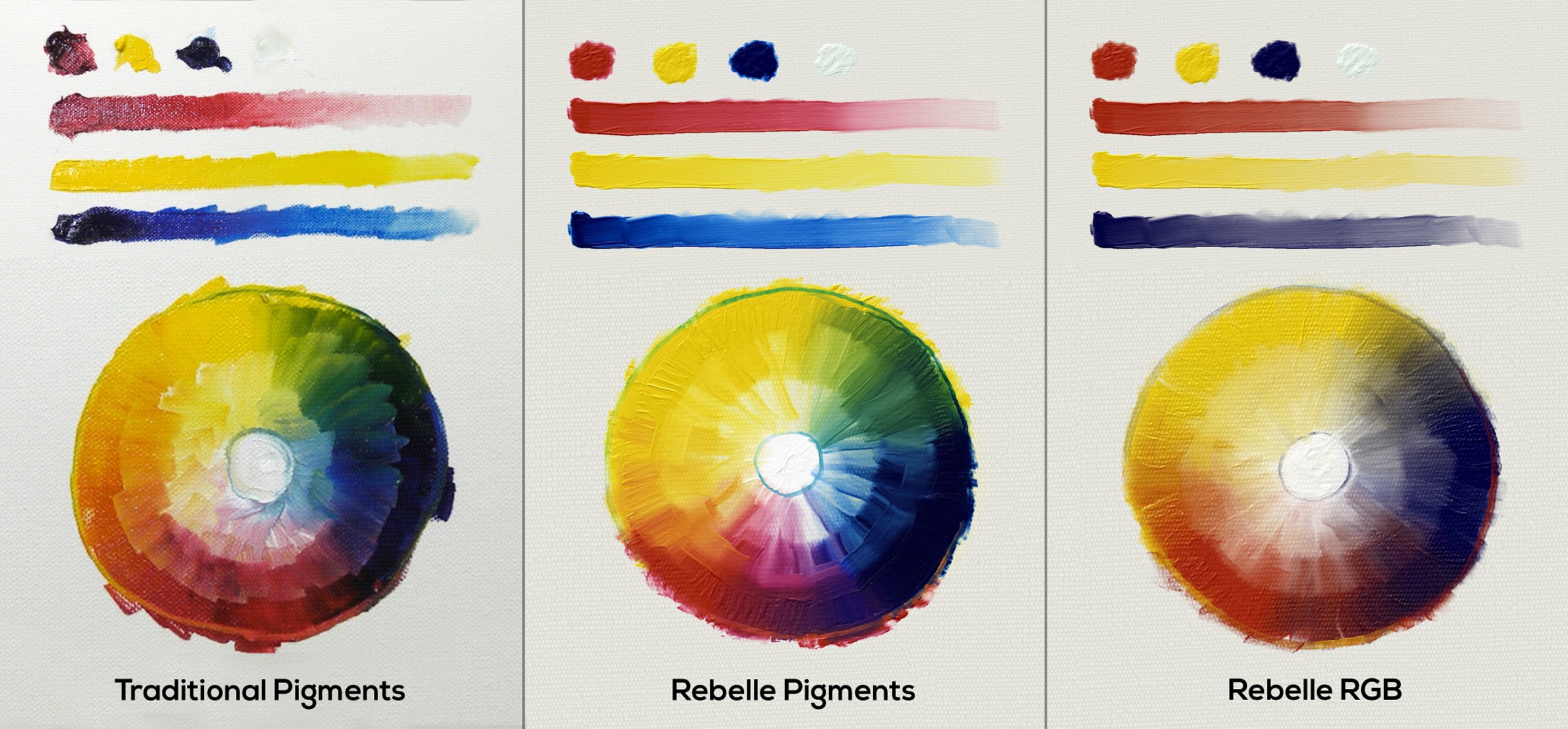 Comparison of Traditional pigments vs. Rebelle Pigments vs. RGB
Our solution allows mixing RGB colors as if they were made of actual pigments known from a traditional painting. This model:
- works with real traditional pigments;
- handles all RGB colors without causing clipping or distortion;
- is fast enough to work in real-time.
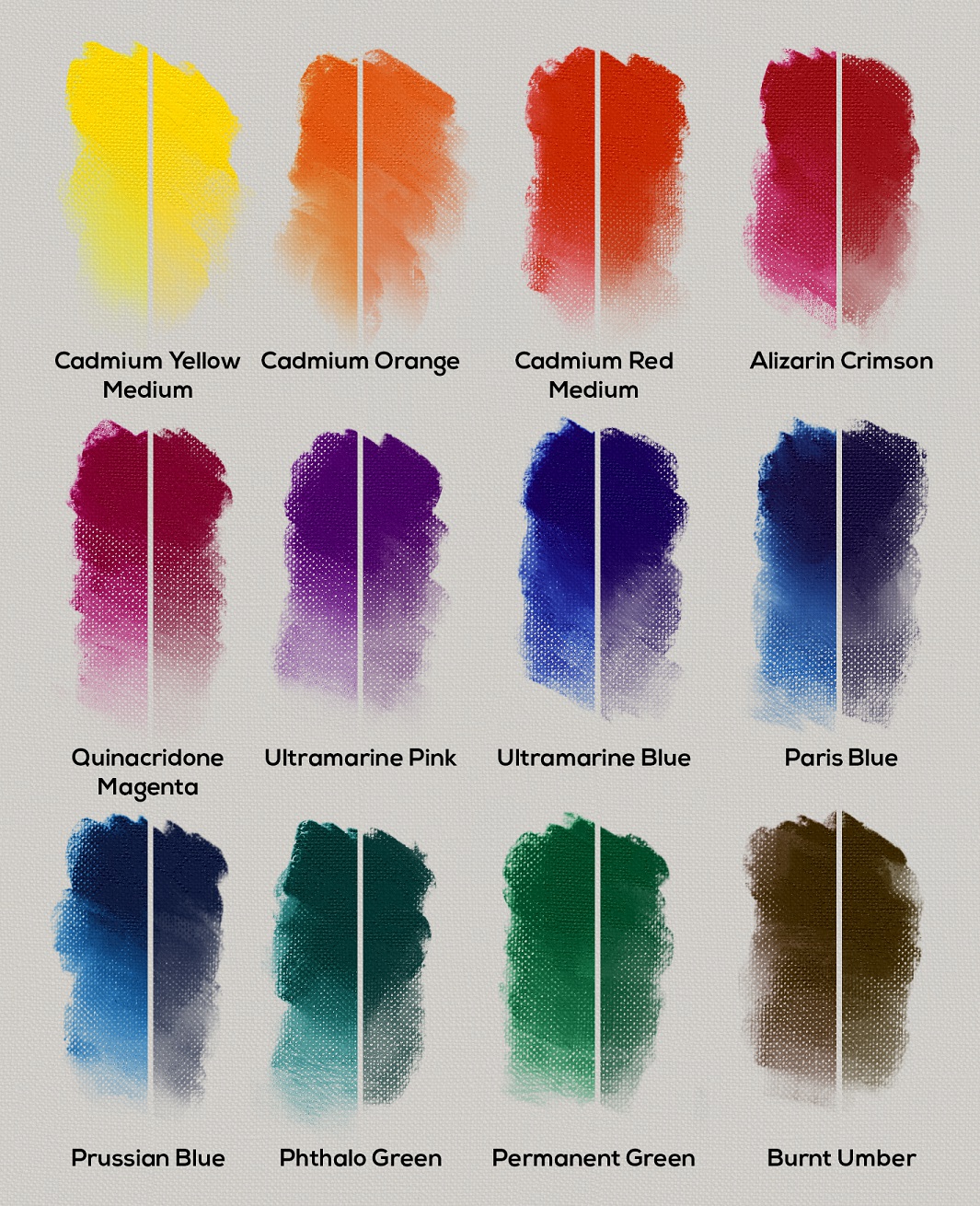 Examples of Rebelle pigments with saturated hue shifts (on the left) in comparison with RGB colors, which are desaturated and dimmed (on the right).
Rebelle is the first software in the world with real physical color mixing based on traditional pigments in a full RGB color gamut.
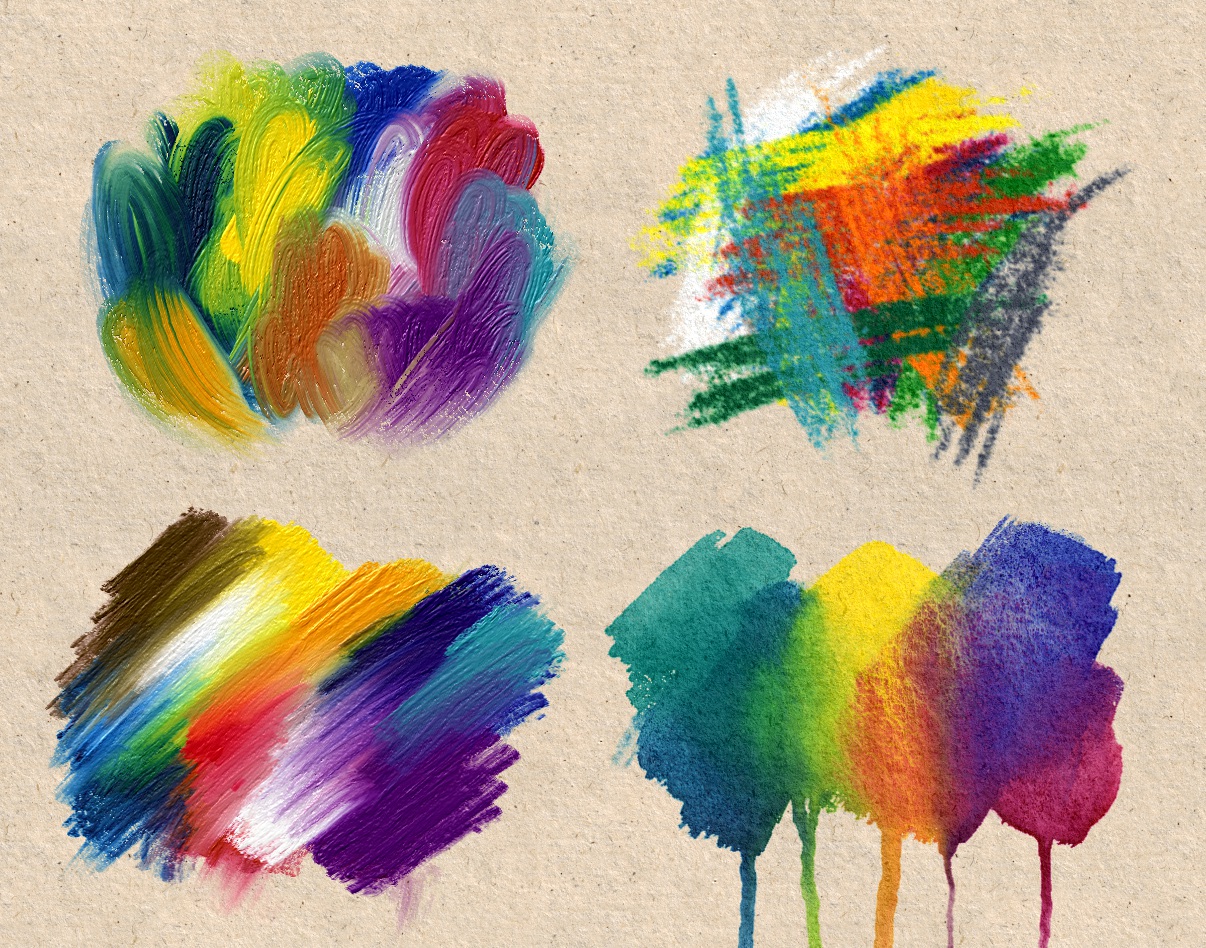 Examples of Rebelle 5 Pigments with different media
With Rebelle 5 we will also introduce new color sets with the actual pigments. Thanks to this mixing method, all simulated media such as oil paints, watercolors, or pastels look realistic and natural. The paints blend intuitively and produce vibrant hues and secondary colors: orange, violet, or green.
We believe Rebelle 5 helps artists struggling with the digital mixing of their colors. It will surely open up the digital world to traditional artists even more. Digital painters will be able to create more vivid colors that naturally bend away from gray, producing secondary hues while preserving saturation.
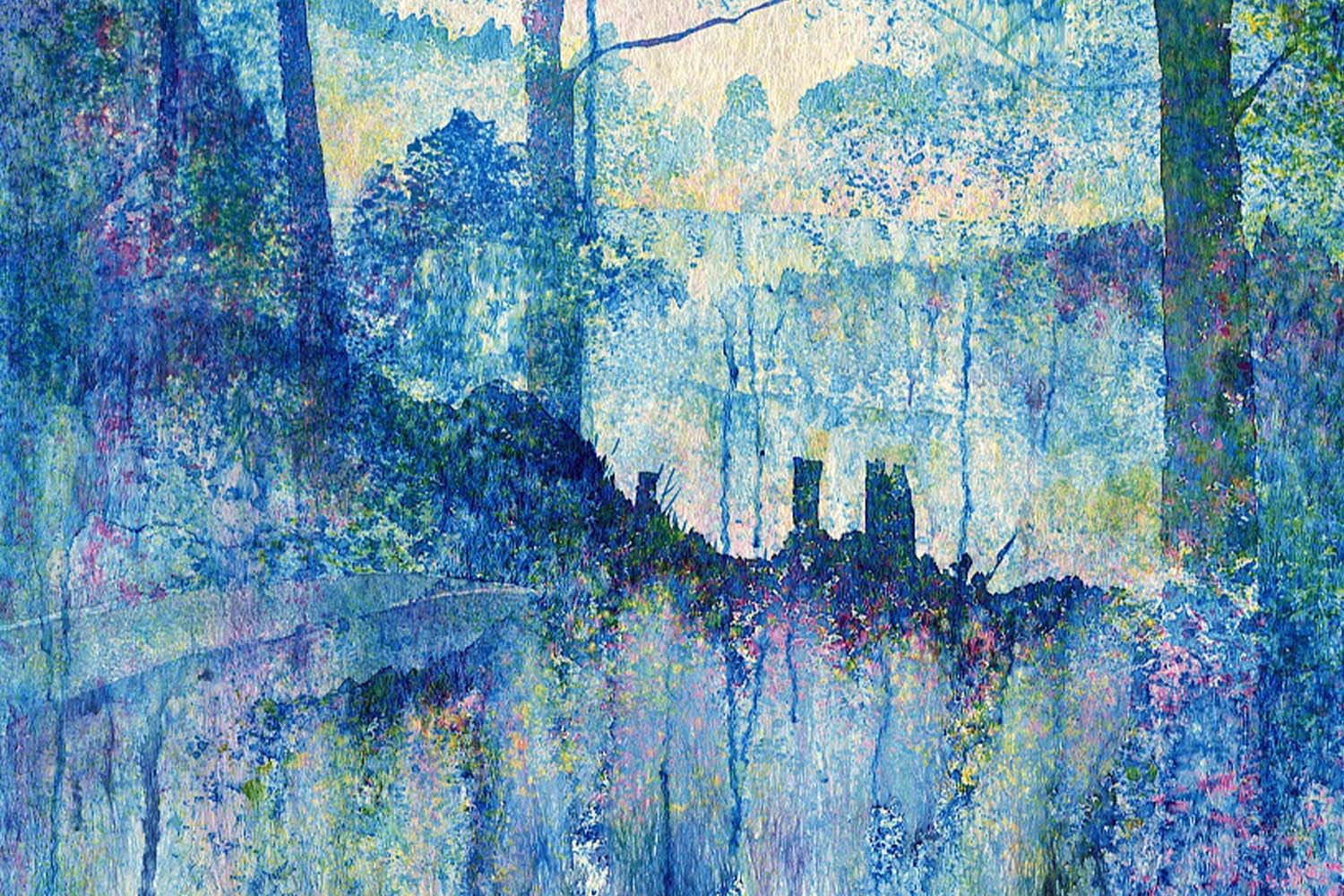
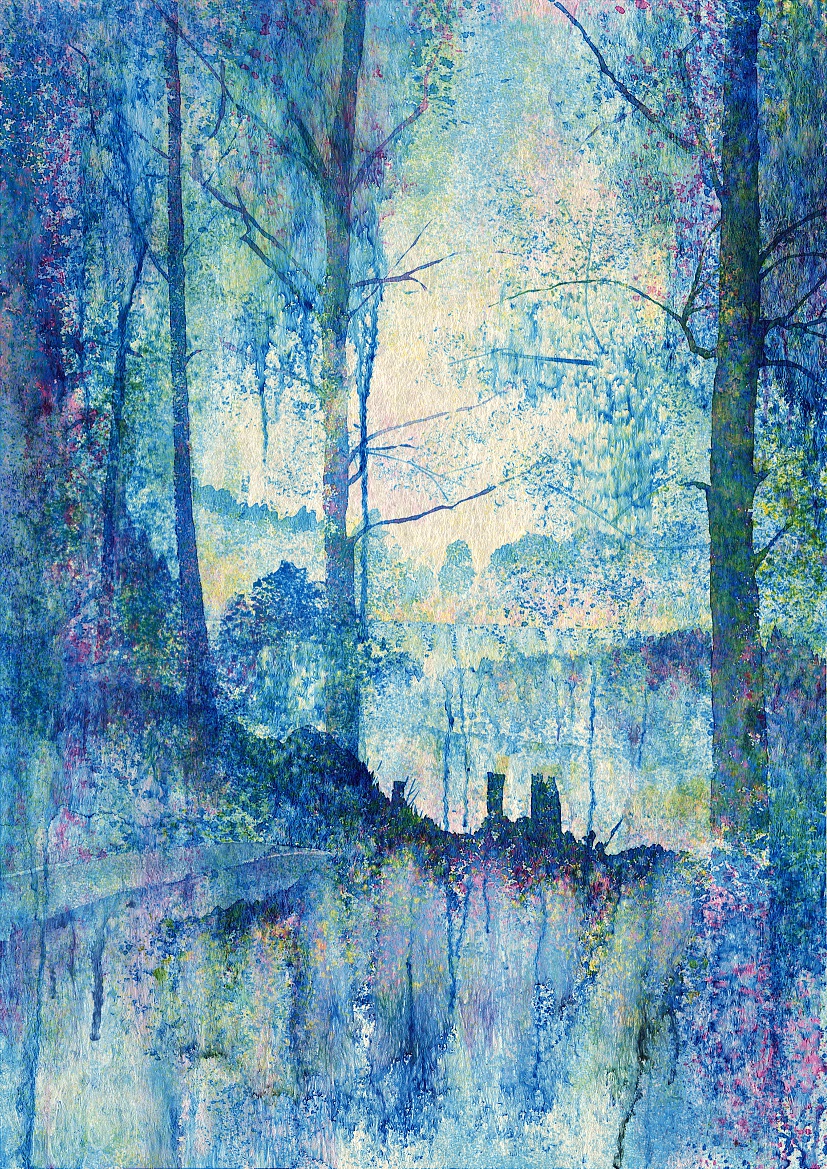 Artwork by Ľubomír Zabadal in Rebelle 5 using Pigments
Are you ready for the revolutionary Rebelle 5? In addition to the new Pigments color mixing, it will bring more useful innovations we will cover in the next few blogs: NanoPixel technology, new features for oils, acrylics and watercolors, and more. Stay tuned!
Rebelle 5 is coming in two different editions - Standard and Pro. All existing owners of Rebelle 4 are eligible for a 50% upgrade discount. All users who purchased Rebelle 4 from October 15th, 2021 until the release of Rebelle 5 will be eligible for a free upgrade to Rebelle 5 Standard. That means if you want to give Rebelle a try right now, you should!
NEWS from 8.12.2021: Technical paper about pigment mixing will be presented by Šárka and Ondra at SIGGRAPH Asia 2021 with other state-of-the-art papers. What's more, the paper and Rebelle in action are included in the featured SIGGRAPH trailer video. What a great success! Learn more about "Mixbox" pigment mixing at Secret Weapons website.
Keep it creative!
Your Escape Motions Team

What do you think?
0 Responses
0
Upvote
0
Funny
0
Love
0
Surprised
0
Angry
0
Sad
Sign in to comment!
Is possible get what price is upgrade to pro 5? when i have allready 4. i hope i can get it soon... i need so much i must think again things when i see this.
If I upgrade from Rebelle 3 to 4 now do I get rebelle 5 as well for free?
Yes, if you upgrade to Rebelle 4 now, you will get Rebelle 5 standard edition for free.
what features has the pro version, and will there be an upgrade too?
Yes, there will be an upgrade too. We will write about difference between two editions in the last blog about Rebelle 5.
I ordered it but I would have a better feeling if you could make clear what are the differences. Hope you do not show us all those features and in the end tell us oh they are all Pro features.
Please never never a subscription model! I'd abandon my wife and kids (if I had any of those) if they became "subscription-only".
Rebelle has a perpetual license - you can to use the software indefinitely.
Do all my current papers etc work in rebelle 5?
Yes, all purchased papers work.
This sounds exiting, but I hope you have improved screen updating in the upcoming fiver. If I have 4-5 layers it takes forever to swap visibility - and I work on a pretty new iMac
We know about this issue for larger canvases and our aim is to optimize the performance with every version.
now I’m wondering what the price uplift between standard and pro is… and what features I’ll be missing with standard…
Hello, we will reveal more about that in the next blogs.
this is very exciting, I have been waiting for someone to do this right for 30 years in digital! Except I just purchased on October 8, 2021! there has to be some wiggle room in that, right? 1 week off and I have to pay full price?
Hello, for sure you have not to pay a full price, we will write about that in the next blog posts. If you are concerned about that, just send us an email.
Hello looking forward to it! So if I have Rebelle 4 which I bought back in March, then does that mean I have the right to upgrade to Rebelle 5 or do I have to buy it separately or only partial tax, how does it work? Thanks!
Based on this post, you will have a 50% discount on the price if you already have Rebelle 4, but yes you will need to buy it an upgrade if you want to use Rebelle 5.